Matt's Top 3 Facebook Ads - March 2018

Matt Jantz • April 7, 2018

Each month GoBeRewarded spends THOUSANDS of $$$ on Facebook ads for our clients in North County San Diego. See what is working for us!
A facebook logo with a sign that says your ad here

What Criteria was used for choosing the top ads?

Relevance Score. This metric - provided by Facebook - is available for every single ad through the ads reporting tools section of Facebook's Business Manager . Each of the ads I selected has a minimum relevance score of 8 out of a possible 10. Relevance scores are calculated using an algorithm that varies directly with positive user interactions depending upon the ad's objective. Relevance scores are the FIRST metric I look at to determine if an ad was successful. Learn more about relevance scores from Facebook. Keep in mind this score is only available once your ad has been served to at least 500 people.

# Shares. Shares are when a user shares a Facebook ad with his or her friends on the user's own timeline, a friend's timeline, in a group, or in a private message to a friend. This is awesome because your content's reach is being amplified and is now being shown to a larger audience without it costing you more money. The user who shares your content feels connected to your brand and wants to promote you.

# Likes & Comments. Facebook likes are exactly what the term implies; a user appreciates and likes your content!

#Offer Claims. Offer ads are discounts your business shares with Facebook users to encourage a purchase of your product or service. Users who "claim" these offers are indicating a clear interest in your business and expressing intent to buy from you in the near future. Check out our article all about Facebook Offers.


23 POST SHARES! Relevance Score: 8

This ad for Hamburger Factory in Poway spent $9.96, reached 987 users an average of 2 times over a 6 day period, resulting in 132 link clicks!

If you want to achieve results like this with a small budget, you need to spend time on both your ad content and your ad targeting. This post was shown to two custom audiences: Hamburger Factory website visitors from the past 180 days and users who have engaged with the restaurant's ads, call-to-action button, or page in the past 365 days. This ad's objective was link clicks and the placement was for all device types .
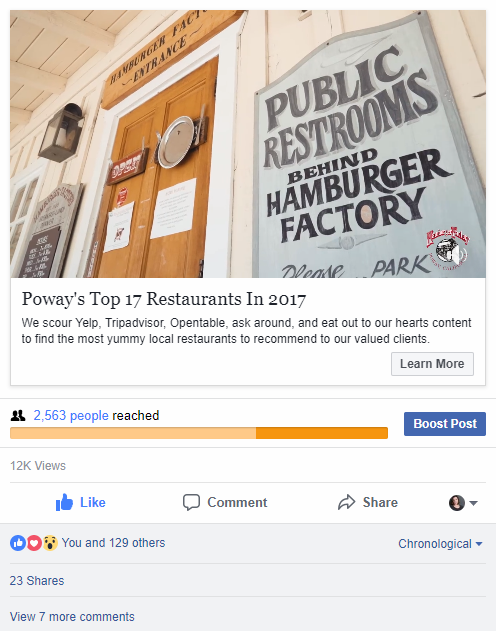
A facebook post about public restrooms behind hamburger factory

94 LIKES & 19 COMMENTS! Relevance Score: 8

Petite Madeline Bakery in Oceanside was able to reach 869 Facebook users 2 times each with this $10.00 ad over a 5 day period, resulting in 115 post engagements!

The ad targeting on this post was simpler than my last ad, I specified users who had already liked the business' Facebook page. For this ad I set the objective as post engagement; I also set the placement to only show on mobile devices .

A bunch of desserts on a table next to a facebook post

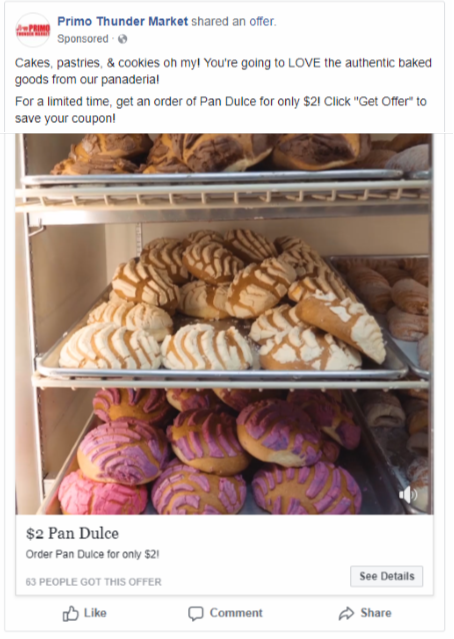
63 OFFER CLAIMS! Relevance Score: 9

Our client, Primo Thunder Market, in Vista spent $10.00, reaching 881 users an average of 1.5 times over a 5 day period.

This Facebook Offer ad targeted users within 2 miles of the business' address ages 18-65+ who speak Spanish and are interested in burritos, tamales, tacos, enchiladas, and other traditional Mexican foods. This ad's objective was traffic and placements were set to automatic .
A facebook ad for a bakery shows a variety of pastries

Want to meet me for an in person workshop? Check out my upcoming Facebook workshop in San Marcos next week.

A magnifying glass over a document against a light blue background with icons of a key, paper plane, and the text
March 12, 2026
Search engine optimization, or SEO, is often talked about as one thing, but it actually includes several different types of work. Two of the most important are on-page SEO and off-page SEO . Both influence how your website performs in search results, but they focus on different parts of your online presence. What Is On-Page SEO? On-page SEO refers to everything you optimize directly on your website to help search engines understand your content.  This includes things like: Page titles and meta descriptions Headings and page structure Keyword usage in the content Internal linking between pages Image optimization and site speed The goal of on-page SEO is to make your website clear, organized, and easy for search engines to understand. What Is Off-Page SEO? Off-page SEO refers to signals that happen outside of your website but still influence how search engines evaluate it. The most common example is backlinks , which are links from other websites pointing to yours. When reputable websites link to your business, search engines see that as a sign of credibility. Off-page SEO can include: Backlinks from other websites Business directory listings Local citations Online mentions of your business Why Both Matter A well-optimized website is important, but it is only part of the picture. Search engines also look for signals that your business is trusted and referenced elsewhere online. Strong SEO typically comes from a combination of both a well-structured website and credible external signals.
Two people, woman and man, looking at a computer screen together at a desk.
February 28, 2026
Learn how Google Ads is tightening phone number and business info rules in 2026, and what small businesses must do to stay compliant and maximize ad performance.
February 6, 2026
Most business owners only hear about DNS when something stops working. It sounds technical, but the concept is actually straightforward and extremely important to understand. DNS is the system that tells the internet where your website, email, and other services live. More importantly, whoever controls your DNS effectively controls access to your online presence. That is why every business owner should make sure they own their domain and have access to their DNS settings. What DNS Is DNS stands for Domain Name System. Think of it as the internet’s phonebook. When someone types your website address into a browser, like www.yourbusiness.com , DNS translates that domain name into the numerical IP address where your website is hosted. Once the correct server is found, the website loads. Without DNS, people would have to type long strings of numbers instead of simple domain names. What DNS Controls DNS does more than just point visitors to your website. It also directs other critical services connected to your domain, including: Your website hosting Your business email Subdomains like blog.yourbusiness.com Verification records used by tools like Google or Microsoft In short, DNS acts as the traffic controller for many parts of your digital infrastructure. Why Business Owners Should Care One of the most common problems businesses run into is losing access to their domain or DNS because it was registered under a developer, agency, or former employee. When that happens, you may not be able to: Move your website to a new provider Change email services Connect marketing tools Fix website or email issues Your domain and DNS act as the gateway to your entire digital presence. If you do not control them, someone else does. What Every Business Should Do Every business owner should make sure of three things: Your business owns the domain name You know where it is registered and have login access You can access the DNS settings if needed Even if a developer or marketing agency manages things for you, the account should always belong to the business.