
Increase Discoverability with Easy Local Business Schema
Increase site discoverability and make it easier for search engines to understand key facts about your website’s business with Local Business Schema.
Schema.org helps robots and crawlers understand facts about a website, business, people, or the content on a web page. Duda has made it easy to enable Local Business Schema on your site by filling in the content library of any site we are building. Duda makes sure that we have the right kind of data to accurately reflect the schema. This is important to make sure that the schema is valid with Google and other search engines that rely on schema.
More about Schema
Schema markup is code that makes it easier for search engines, crawlers and browsers to understand structured data regarding a site’s content or business, and it makes it easier for search engines to identify the websites of businesses with a physical location.
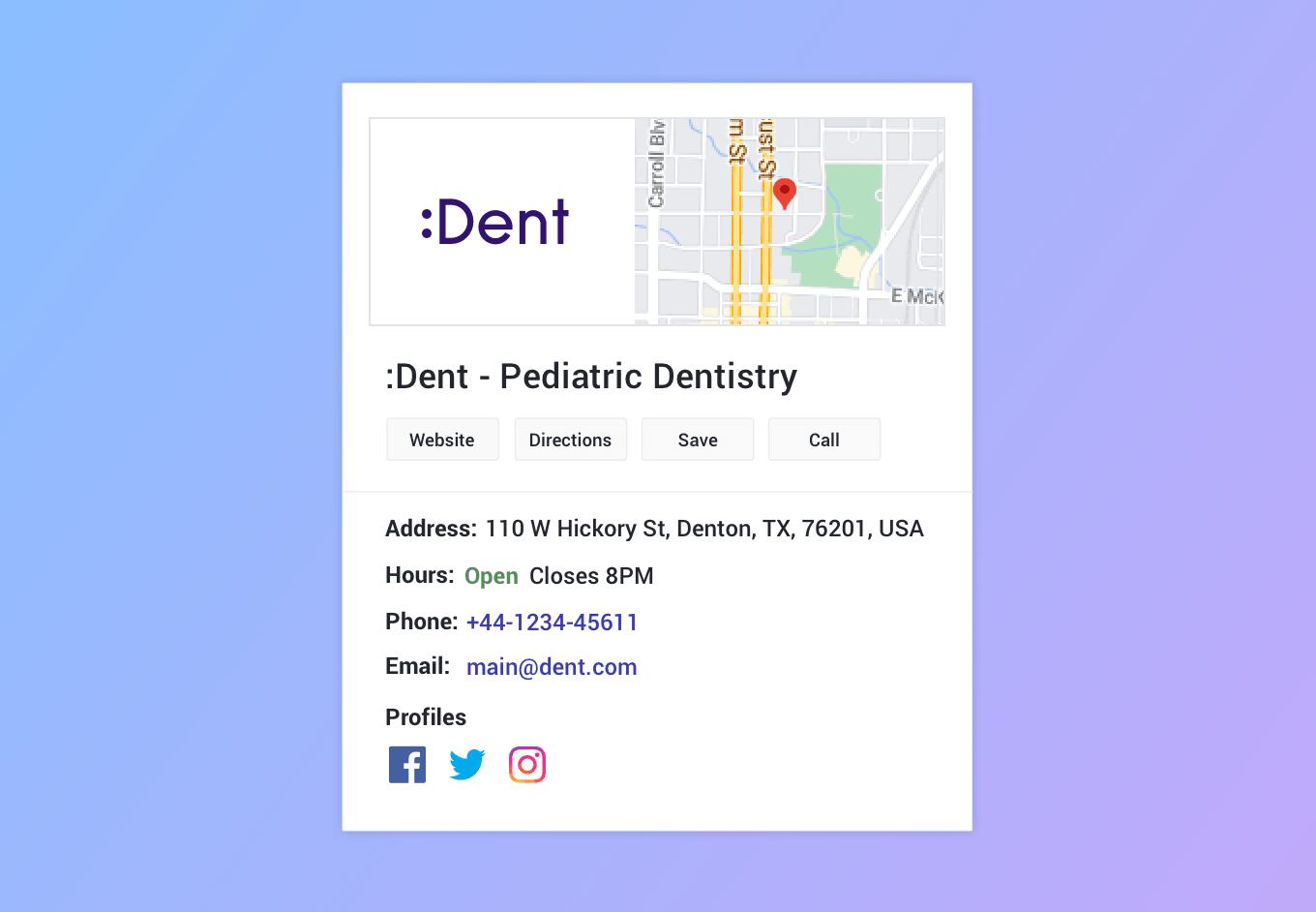
Google and other search engines use Local Business Schema to enrich their knowledge about a business. When a local search is conducted, this empowers them to know and display the following information:
- When the business is open/closed.
- A business’s logo (and present it in the knowledge graph card on the right side of the Search results page).
- The phone number of a business if someone searches for "{business name} phone number".
As a result, the search engine returns the website in relevant search results.
Supported fields
| Content Library Field (Business Info) | Schema Use |
|---|---|
| Business Name | The name of the business as it is most commonly represented to customers. |
| Address | The physical address of a business. |
| Geo | The latitude / longitude that represents the business's location. This is automatically generated when an address is entered. |
| Social Networks | Social profiles of the business. These are represented in schema as other URLs where the business can be found. |
| Business Hours | Hours that the business is open. |
| An email address for contacting the business. | |
| Phone | A phone number for contacting the business. |
| Logo | A logo that represents the business |
| Images | Images that represent the business. |
| About us | A short description giving a short overview of the business. |
Originally posted at Duda.co